[Book] Encrypting and Decrypting a Software
Last Update:
Word Count:
Read Time:
El libro
Introduction
This article is used to keep notes and summaries of the book “Encrypting and Decrypting a Software”.
The content will be continuously updated as I read through the book.
Reflection
This book covers many topics and has almost 1,000 pages.

The book includes the following topics:
- Software cracking (patching and bypassing)
- Mathematical cryptography (with formulas and expressions)
- Software vulnerabilities (stack buffer overflow and heap buffer overflow)
- Software packing, unpacking, and packer stubs
- Reverse engineering
Most of the topics focus on Windows rather than Linux.
Personally, I do not recommend this book for beginners in reverse engineering. Although the topics are broad, the book does not explore them in great depth. While the book introduces a wide range of topics, some of them could benefit from more detailed explanations, which may make the book less accessible to beginners.
There are several typos in the book, such as misusing the terms byte and bit, which was quite confusing.
The biggest drawback is that the example source code is very difficult to obtain for foreign readers. It would be excellent if the authors uploaded their source code to GitHub, similar to the author of Reverse Engineering Core.
On the other hand, since the book covers many topics, it can be used as a reference or dictionary. In addition, it includes some topics that are rarely discussed in other books.
Chapter 1 - Fundamental Knowledge
1.3 - Windows OS
Win32 API
- Kernel (kernel32.dll): Processes, threads, memory, file IO, etc.
- User (user32.dll): Mouse click, keyboard input, window, menu, etc.
- GDI (gdi32.dll): Display text.
- advapi32.dll
- comctl32.dll
- comdlg32.dll
- shell32.dll
- netapi32.dll
For Win32 API functions, “A” stands for ANSI. “W” stands for Widechars(Unicode).
1 | |
WOW64
WOW64 stands for Windows on Windows 64-bit.
Windows Message Mechanism
SendMessage()1
2
3
4
5
6LRESULT SendMessage(
HWND hWnd,
UINT Msg,
WPARAM wParam,
LPARAM lParam
);
WM_COMMAND1
2
3
4WM_COMMAND
wNotifyCode = HIWORD(wParam);
wID = LOWORD(wParam);
hwndCtl = (HWND)lParam;
WM_GETTEXT1
2
3WM_GETTEXT
wParam = (WPARAM)cchTextMax;
lParam = (LPARAM)lpszText;
WM_QUIT1
2WM_QUIT
nExitCode = (int)wParam;
WM_LBUTTONDOWN1
2
3
4WM_LBUTTONDOWN
fwKeys = wParam;
xPos = LOWORD(lParam);
yPos = HIWORD(lParam);
Virtual Memory
Chapter 2 - Dynamic Analysis
2.1 - OllyDbg
BreakPoint
- INT 3 OllyDbg replaces the original instruction to
1
004013A5 CC D04040000xCC. However, the original instruction in displayed. Hardware BreakPoint
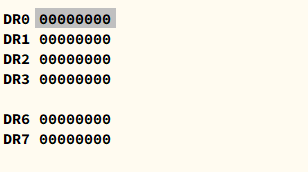
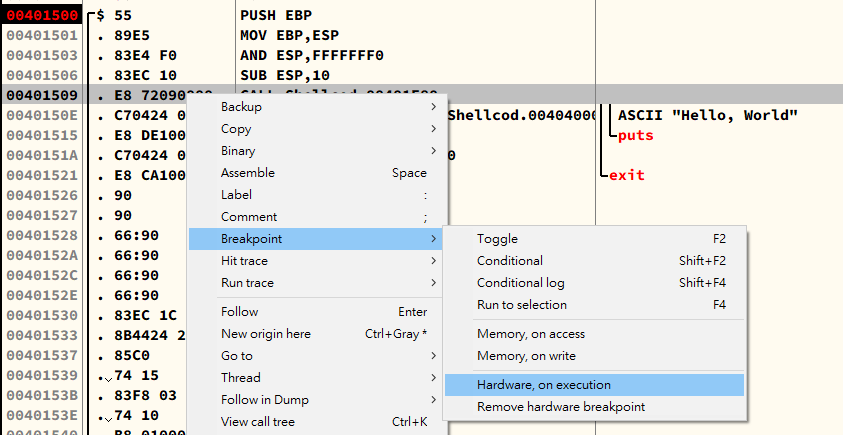
Hardware break points are implemented withDRxregisters. The addresses of break points are stored intoDR0~DR3, whileDR7stores the status. Thus, the maximum number of hardware break points are is 4.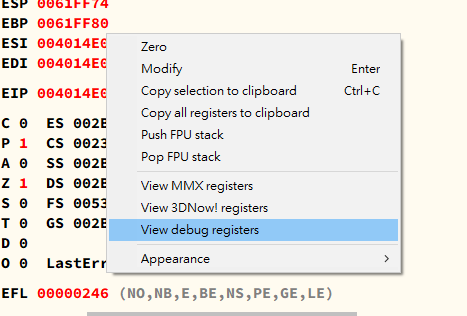
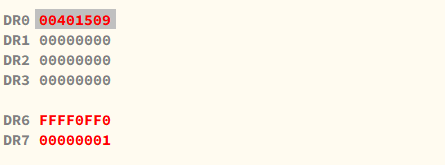
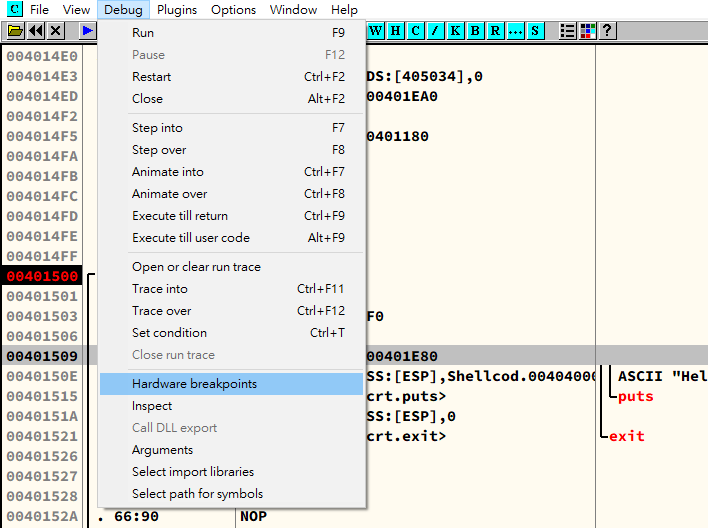
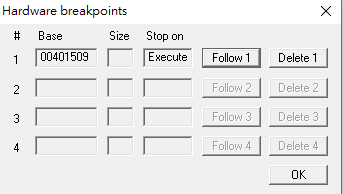
Memory BreakPoint
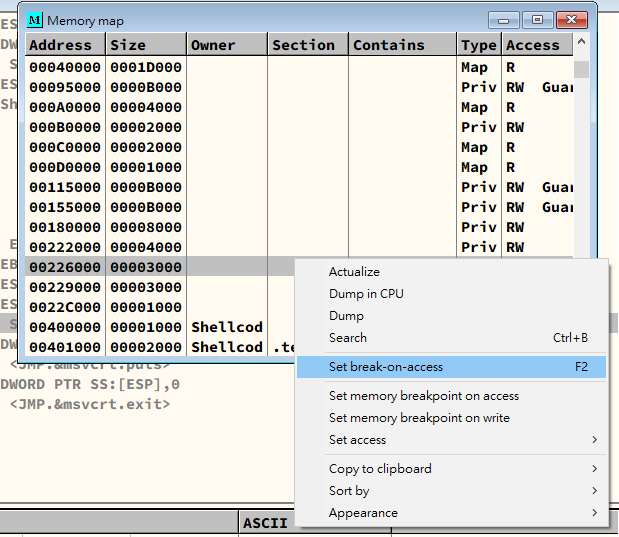
- On Access
On Write
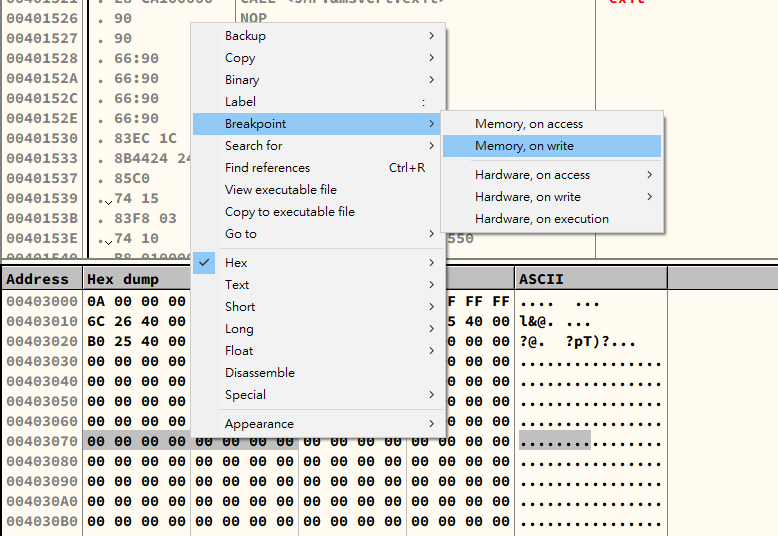
Set break-on-access
Message BreakPoint
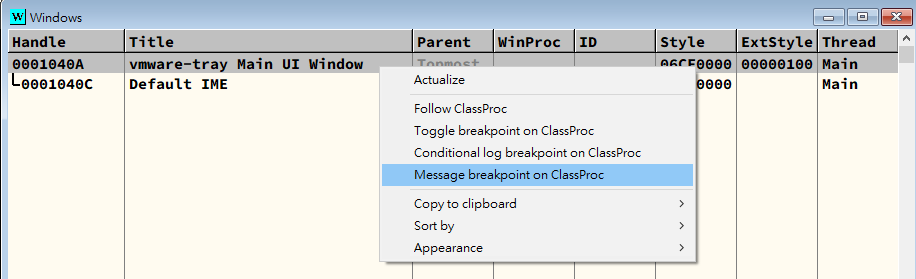
- View -> Windows
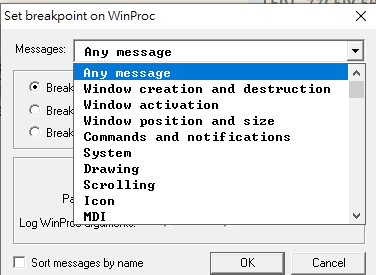
Message breakpoint on ClassProc
Conditional BreakPoint
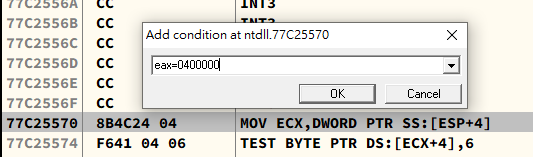
Shift+F2 - Conditional Log
2.3 - MDebug
2.4 - WinDbg
Chapter 3 - Static Analysis
3.2 - Disassembly Engine
- ODDisasm
- BeaEngine
- Udis86
- Capstone
- AsmJit
- Keystone
3.3 - Static Disassembly
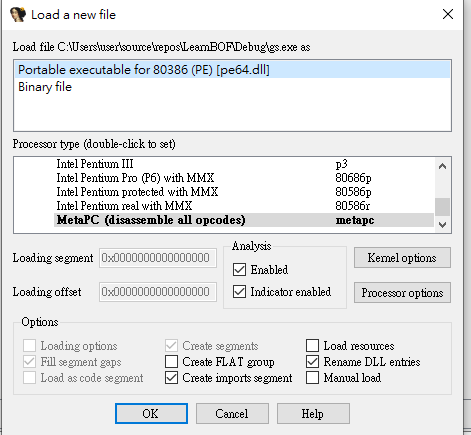
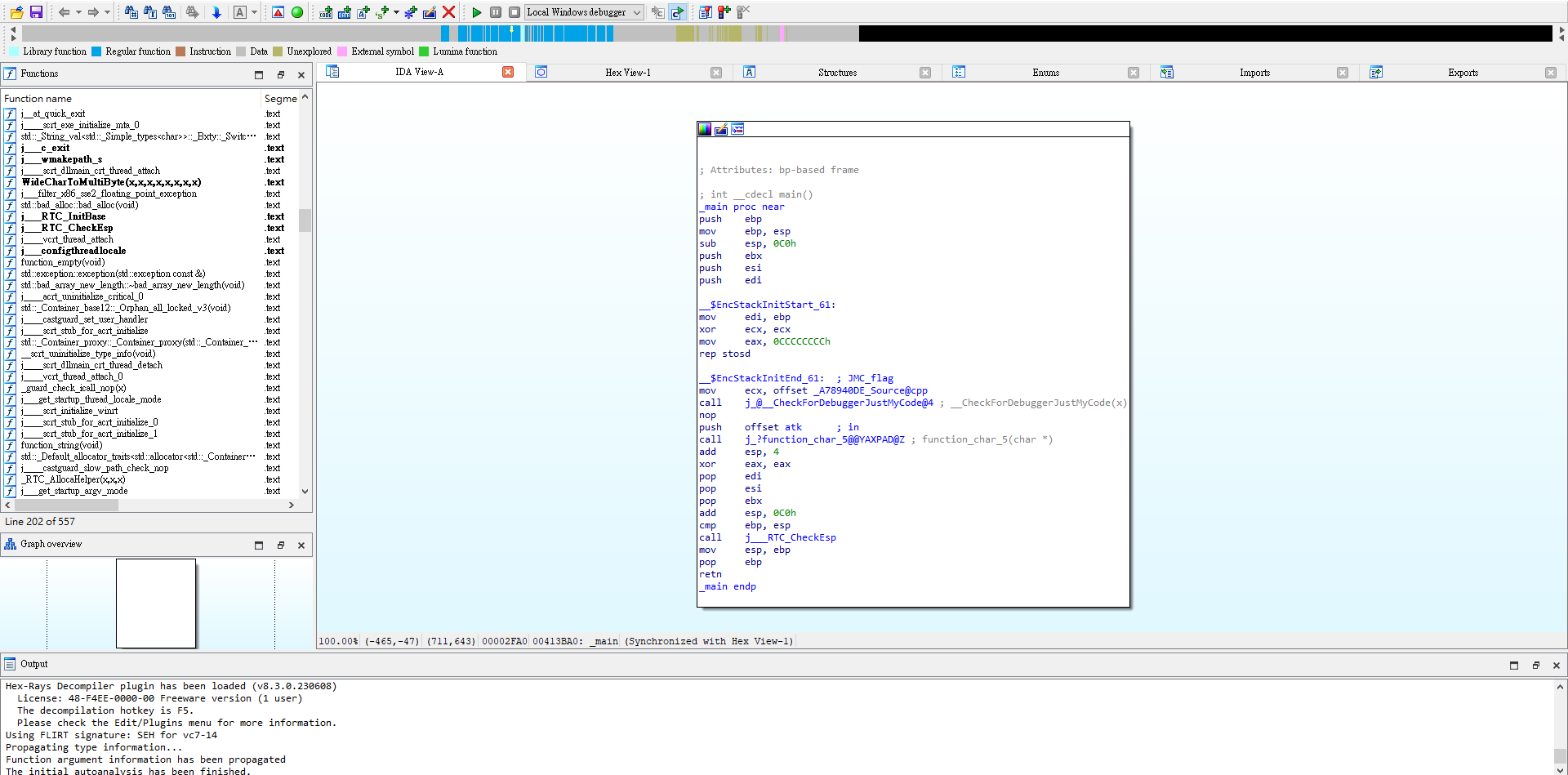
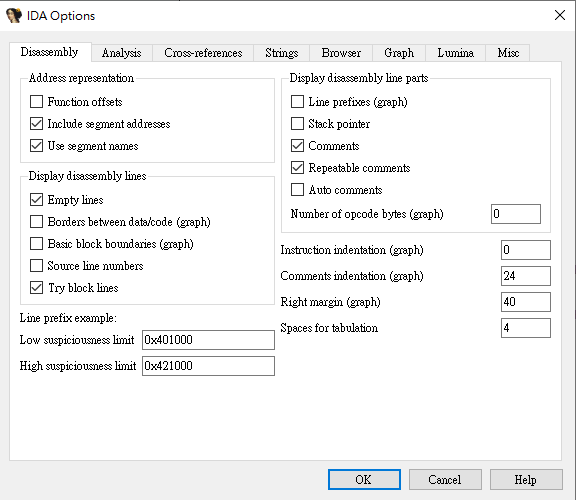
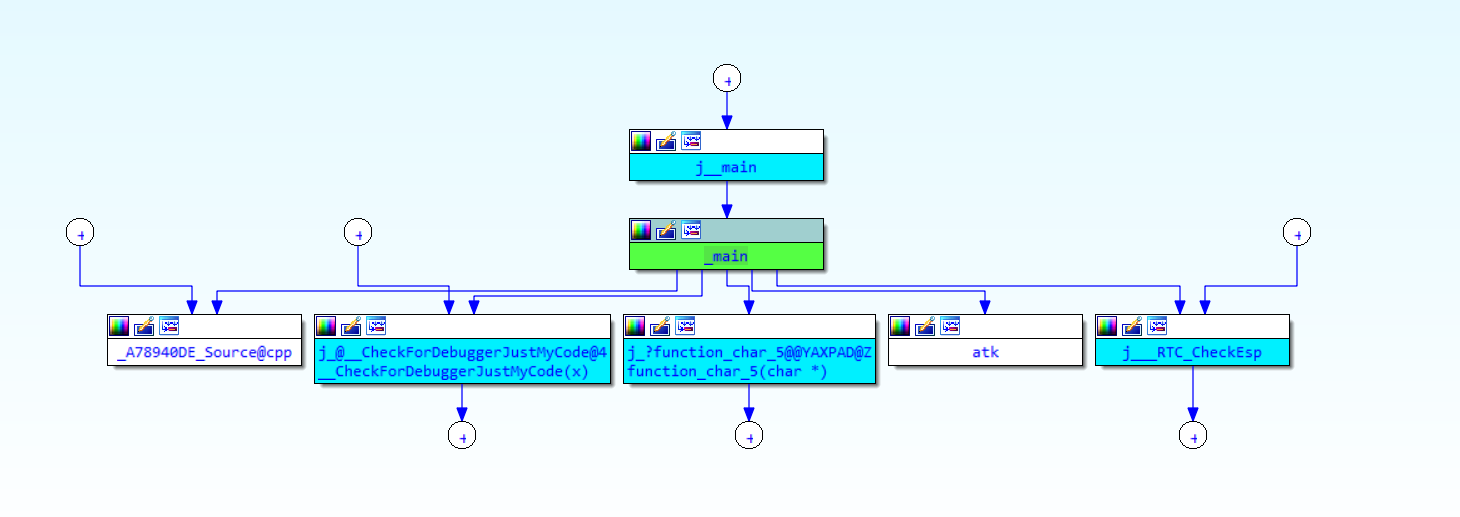
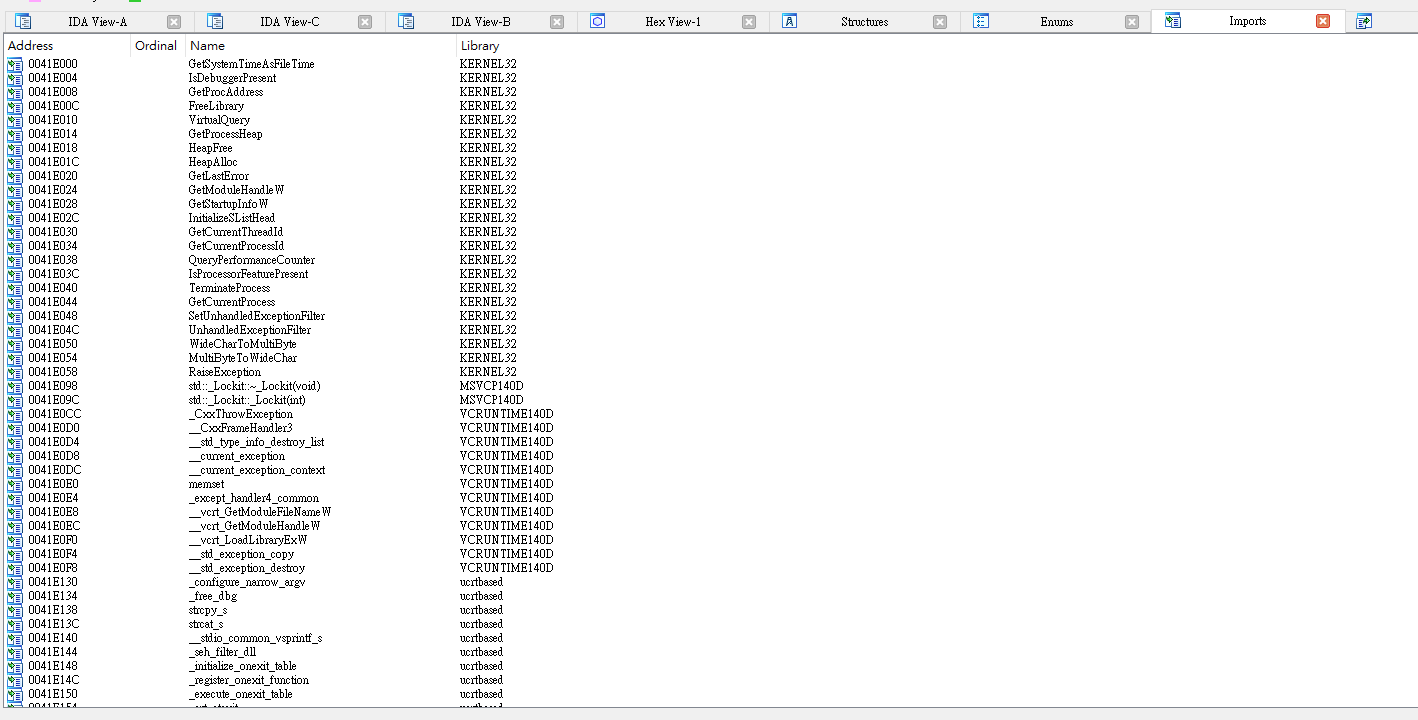
IDA
Hexadecimal Tools
- HexWorkship
- WinHex
- Hiew
Chapter 4 - Reverse Engineering Techniques
4.1 - Reverse Engineering on x32 Platform
Calling Convention
Example1:1
test1(p1, p2, p3);
__cdecl1
2
3
4
5push p3 ; right to left
push p2
push p1
call test1
add esp,0C ; stack cleanup
pascal1
2
3
4push p1 ; left to right
push p2
push p3
call test1 ; stack cleanup in the function
stdcall1
2
3
4push p3 ; right to left
push p2
push p1
call test1 ; stack cleanup in the function
Example2:1
test2(p1, p2);
stdcall1
2
3
4
5
6
7
8
9
10
11
12
13
14
15
16
17push p2 ; Parameter 2
push p1 ; Parameter 1
call test2
{
push ebp ; Original EBP pointer
mov ebp, esp ; New EBP pointer
mov eax, dword ptr[ebp+0C] ; Parameter 2
mov ebx, dword ptr[ebp+08] ; Parameter 1
sub esp, 8 ; Reserve space for local variables
...
add esp, 8 ; Release space of local variables
pop ebp ; Original EBP pointer
ret 8 ; return (Equal to ret # add esp, 8)
; 2 (Parameter) x 4h = 8
}
- enter: push ebp # mov ebp,esp # sub esp, xxx
- leave: add esp, xxx # pop ebp
We can rewrite the script above1
2
3
4
5
6enter xxxx, 0 ; Reserver space xxxx for local variable
...
leave
ret 8
Enable Maximum Speed in VC6.01
2
3
4
5
6
7
8
9
10
11push p2
push p1
call test2
{
mov eax, dword ptr [esp+04] ; Call parameter 1
mov ecx, dword ptr [esp+08] ; Call parameter 2
...
ret 8 ; return
}
Virtual Function
Chapter 5 - Software Protection Demonstration
5.1 - Serial Number and KeyGen
Exploiting Serial Number Protection Mechanism
Commonly used API functions for Serial Number Protection:
- The following functions are commonly used for input:
- GetWindowTextA(W)
- GetDlgItemTextA(W)
- GetDlgItemInt
- hmencpy (Windows 9x/Me only)
- The floowing functions are commonly used for messagebox:
- MessageBoxA(W)
- MessageBoxExA(W)
- ShowWindow
- MessageBoxIndirectA(W)
- CreateDialogParamA(W)
- CreateDialogIndirectParamA(W)
- DialogBoxParamA(W)
- DialogBoxIndirectParamA(W)
- Other functions:
- Serial number might be stored in registry:
- RegQueryValueExA(W)
- Serial number might be stored in an INI file:
- GetPrivateProfileStringA(W)
- GetPrivateProfileIntA(W)
- GetProfileStringA(W)
- GetProfileIntA(W)
- Serial number might be stored in other file:
- CreateFileA(W)
- _lopen()
- Serial number might be stored in registry:
KeyFile Protection
| API Function | Description |
|---|---|
| FindFirstFileA | |
| CreateFileA, _lopen | |
| GetFileSize, GetFileSizeEx | |
| GetFileAttributesA, GetFileAttributesExA | |
| SetFilePointer, SetFilePointerEx | Mov |
| ReadFile | Obtain file content. |
5.7 - Disk Protection
5.8 - Single Instance
Chapter 6 - Cryptography Algorithm
6.1 - Hashing
MD5
MD5 stands for Message Digest Algorithm 5.
SHA
SHA stands for Secure Hash Algorithm.
- SHA-1
- SHA-256
- SHA-384
- SHA-512
6.2 - Symmetric Encryption
- DES (Data Encryption Standard)
- IDEA (International Data Encryption Algorithm)
- AES (Advanced Encryption Standard)
- BlowFish
- TwoFish
RC4
RC4 stands for Rivest Cipher 4.
KSA (Key-Scheduling Algorithm)1
2
3
4
5
6
7
8
9
10
11
12
13RC4-KSA(Key)
for i := 0 to 255 do
S[i] := i
end for
j := 0
for i := 0 to 255 do
j := (j + S[i] + Key[i mod keylength]) mod 256
swap S[i] and S[j]
end for
return S
PRGA (Pseudo-Random Generation Algorithm)1
2
3
4
5
6
7
8
9
10
11
12RC4-PRGA(S)
i := 0
j := 0
while true do
i := (i + 1) mod 256
j := (j + S[i]) mod 256
swap S[i] and S[j]
t := (S[i] + S[j]) mod 256
K := S[t]
output K
end while
TEA
TEA stands for Tiny Encryption Algorithm.
1 | |
1 | |
Where:
IDEA
BlowFish
AES
Chapter 7 - Windows Kernel Fundamentals
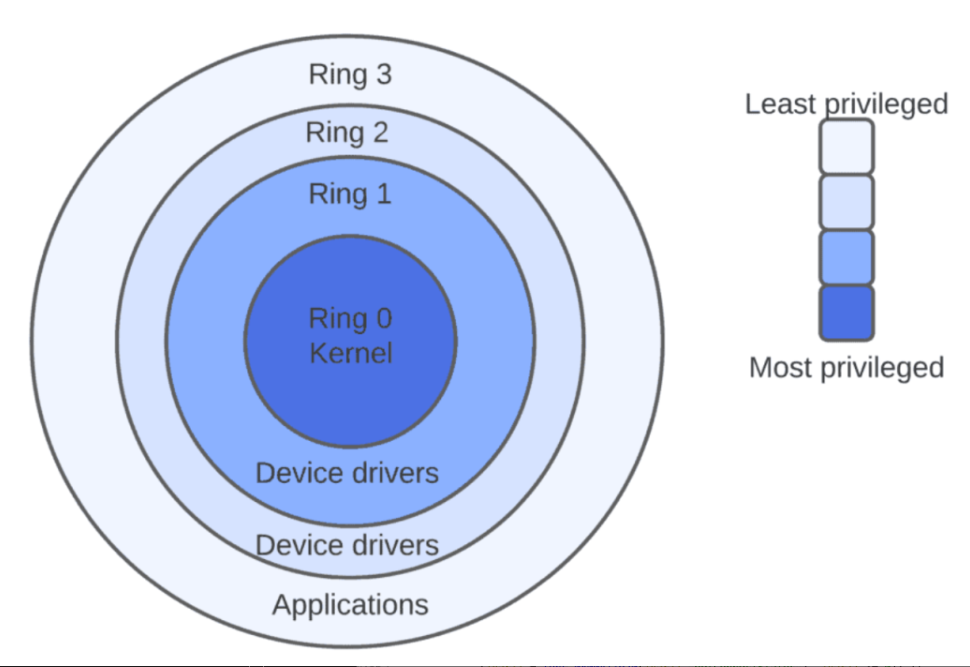
7.1 - Kernel Fundamentals
7.2 - Important Kernel Data Structure
7.3 - Fundamentals of Kernel Debugging
Chapter 8 - Windows Exception Handling
8.1 - Fundamentals of Exception Handling
1 | |
When an interrupt or exception occurs, the CPU looks up the corresponding handler in the IDT.
The IDT (Interrupt Descriptor Table) is a linear table stored in memory. It consists of 256 entries. Each entry is 8 bytes long on x86 (32-bit) platforms and 16 bytes long on x64 (64-bit) platforms.
The base address and size of the IDT are described by the IDTR (IDT Register). The IDTR is 48 bits long on x86 systems. Although the IDTR can be accessed using the SIDT and LIDT instructions, the LIDT instruction can only be executed with Ring 0 privilege.
8.2 - SEH
Chapter 9 - Win32 API Debugging
Chapter 14 - Vulnerability Techniques
14.1 - Software Vulnerability
Stack Buffer Overflow
Heap Buffer Overflow
1 | |
14.2 - Shellcode
CHapter 15 - Software Unpacking
15.2 - Packer
- UPX
- ASPack
15.3 - Packer Stub
- ASProtect
- Armadillo
- EXECryptor
- Themida
THANKS FOR READING